Showing posts with label YMCA Camping. Show all posts

Wednesday, January 25, 2012

Summer Camper = Better College Student?

In a recent Psychology Today blog, Steve Baskin, the Camp Director at a beautiful private camp in Marble Falls, Texas, wrote the following article suggesting that being a summer camper has advantages much later in life than early childhood. Here's a sampling from Summer Camp - Creating Advantage in College:

Camp helps students adjust to being away-from-home by giving them practice being away-from-home. Campers coming to camp (often as young as Kindergarten or 1st grade) get to experience being separated from home successfully. Certainly, most campers have some homesickness, but the supportive camp community and the fun activities help ease them through this initial challenge. Homesickness is natural. Children will miss their parents.
Further, we live in a society that sometimes suggests to children that they are only safe within eyeshot of their parents. Yet, we parents want our children to grow in confidence and independence so that they can live productive, fulfilling and joyous lives. Camp enables children to experience successful independence. Like college, they are away-from-home. Unlike college, they are in a community committed to their physical and emotional safety.


What are your thoughts? I only spent one summer (two weeks, actually) of my childhood at a traditional, overnight summer camp, so I'm not sure how good my perspective is. By most measures, I was a successful college student from my first semester onward. Can some of those coping mechanisms be attached to even just a short week or two in a traditional camp setting?

It's true— camp is all about community. Specifically, a community that is not part of the traditional family unit. A standard camp cabin, with two "parents" or head counselors, and a handful of children functioning together to keep spaces clean and eat meals and have fun together definitely resembles a family. And it takes a whole lot of cooperation, compromise, and compassion to function well. So does a successful week of camp teach those lessons in the long-haul?

I can't be certain,  but I think Mr. Baskin makes some great points.

— MaryAshley

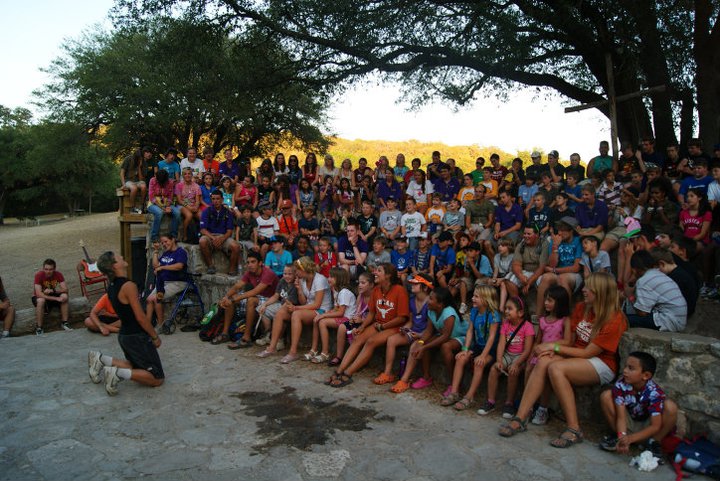
Will having a camp family like this one make for a better college student later on?

Monday, October 24, 2011

Giddy Up, CFA— Your Fall Horse Update

Howdy howdy, campers, staff and families. I haven't written in a few weeks and wanted to share some of the exciting changes we are planning for the YMCA Camp Flaming Arrow's Equestrian Education program in 2012.

Three great NightRyders on Whiskers, Cash, and Rocky.
The NightRyders program was a big hit for 6 of the 8 camp weeks this year. NightRyders offered some of the more advanced teen riders one or two nights during their week to come out and try their hand at a different equine activity— some nights it was beginner jumping, sometimes trying out English or Australian riding styles and saddles, riding bareback, or trying their hand at competitive trail riding obstacles with Tiffany and myself. Some Ryders loped for the first time. This was the first year for the group and participants were chosen on a volunteer basis. Next year, due to demand, we will do our best to ensure in advance riders who are interested and eligible (must be a teen and been enrolled in Saddle Club or another year-round equine activity for at least two years) have a chance to try at least one NightRyder activity. If you have any suggestions for safe, fun, and exciting horse programming for our best riders to try, let us know in the comments section below!

Camp favorite Salty and his Saddle Club rider, Week 7.
Currently, we are in the planning stages of expanding the CFA Saddle Club from 12 to 18 members. To do this safely, we hope to have a total of four equestrian staff who can accommodate two groups of riders on two different curricula, who will rotate trail riding classes, round pen classes, and arena classes.  Each week of summer camp, we have to turn away potential Saddle Club riders who were unable to sign up in time to claim their spot. We hope to serve more horse-crazy (or at least, horse-curious!) children who want to ride.

Young campers giving horseback riding their first try.
With the potential expansion of riders, we will continue to look for quality horses who meet the high standards set for a Great Camp Horse! Not all of ours are beautiful, but it takes calm, courage, intelligence, and patience to be a camp mount and we are in the process of acquiring three new horses this fall. With spring retreats coming, we'll have a chance to see how these horses do in the high-pressure situation of camp, and they may make the cut to be part of our string for summer 2012. The camp mustang colts, Indigo and Flint, are not ready for full-time camper duties yet, but are still undergoing training and fine-tuning and we would love to see them being ridden by advanced campers in 2013.  I'll be attending clinics this fall to continue to develop my own skills, including natural horsemanship workshops and dressage lessons. Hopefully I can bring a lot of that back to CFA

As for your summer 2011 Equestrian Staff, who both love their own brand of competitive trail riding— Tiffany and her horse, Rocky, continue to compete in American Competitive Trail Horse Association (visit ACTHA.us for more information) rides and I continue my involvement with the North American Trail Ride Conference (NATRC.org.) We have facilitated several retreats this fall, with many more planned in the spring, and CFA Adopt-a-Horse riding lessons continue throughout the year. Both of us have acquired mustangs from the Bureau of Land Management and spend time on a daily or weekly basis training them to be great trail horses of the future.

Tiffany & Rocky on a competitive ride near Ingram, TX.
Bandit & I riding near Caprock Canyon.


Happy trails to all of you readers,
And hope your lives are full and happy!

— "MA"

Tuesday, September 27, 2011

CFA Buildings Part 2

This is a continuation from our last blog post about the history of our buildings around camp. Hopefully you learned something new in our last blog. This blog will be no different. Here is part 2 of a 2 part series on the history of CFA's buildings:


The Flag Pole
The flag pole is kind of the center piece of a camp. We meet there every morning and nice to raise and lower the colors. It used to be located in front of Strong Hall and was moved over by the cabins a few years ago when Allison and the Summer '07 staff built this site. You can the remains of where the flag pole used to stand in front of Strong Hall near the GaGa pit.

Wheel & Wagon
Back in the 60's and before these were cabins that the boys stayed in. Later on in camp's life they were equestrian staff housing. Now they are used as the cleaning shed and the Ad Staff office.

Pioneer Health Lodge
Now used as the infirmary for the clinical specialists out at camp the Health Lodge has served many purposes out at camp. Ranging from a bath house to professional staff housing. The biggest debate going on about this building right now is that Ryne thinks there is an elk head stuffed in there but Bill thinks it is a axis deer.

Craft Shed
Before it became the craft shed in the late 90's it was the maintenance shop. Joseph, our current Property Manager, worked out of this until his shop was built at the front of the property. Now the craft shed is where Arts ad Crafts take place during the summer. It is cleaned out and not used in the offseason very often.

Equestrian Center
Not much is known about the history of the Equestrian Center. It has been located in the same place for quite some time now. About 20-30 horses call it home and it probably has the most animal and human traffic on camp.

LIT Pit
Built in the summer 2010 by LITs, the LIT pit is the focal point for late night embers after the dance for Farrow, Ottawa and the LITs.

The Dining Hall
The facility was built in August of 1964. It is two stories and the bottom floor is used mainly for its restrooms and overflow. Little known fact about the dining hall is that there used to be a food elevator (a small pully elevator) that would take food from the kitchen to the bottom floor. Within the past 7 years it finally got air conditioning. No more sweating during meals. The dining hall used to be located down near the pool. Next to it was the tennis courts and trampolines, both of which have been removed from camp.

The Pool
The pool was built the same year as the dining hall (1964). It also had diving boards, which has since been removed because the design of the pool makes any type of diving dangerous. It also added a shade structure added to give the kids who don't want to swim a cool place to hangout and play games.

The Gaga Pit
Built in spring 2010 it quickly became one of camp's favorite places due to the game gaga, especially during snack time. It became so popular that we built another one and put it next to the pool for kids who didn't want to swim.

The Council Ring


We don't know when it was built (it shows up in pictures from the early 50's). It is home to our campfires. It is always filled with songs and laughter. If you know anything about the history of this place, let us know.

The Blakley Chapel

Now home to daily Pow Wows, the Blakley Chapel has been around for a long time, but little is known about its history. We are currently looking to renovate the site to make it as beautiful as it deserves. Let us know if you would like to help or if you know any history behind it.