

By Linda Sue Pochodzay Edwards
What an awfully sad day it had been for the friends of Jesus! They had stood watching sorrowfully, as Jesus hung on the cross dying. They didn't fully understand why it had to happen.
They believed that Jesus was the Son of God, and they remembered how He had healed the sick and made blind people see. They remembered how He had fed thousands of people with just a few loaves of bread and fish. They even remembered how He had caused dead people to come back to life. He was such a good, kind man; why did He have to die?

Just before the sun was beginning to sink into the west, Joseph, one of Jesus' friends, noticed that Jesus was no longer breathing. He hurriedly went to ask Pilate if he could have the body of Jesus so he could bury Him. When Pilate agreed, Joseph and Nicodemus (another friend) carefully wrapped Jesus' body in clean cloths. Then they took Him to a tomb to bury Him.
The next day, the Pharisees started thinking about Jesus. They were the people that had wanted to kill Jesus. They remembered how He had taught them, saying that He would rise again after three days. They were worried that it might be true! They also thought that Jesus' disciples would remember and might try to steal the body from the tomb just so they could say that Jesus rose again. They went to Pilate, suggesting that the tomb be closed up with a huge stone and that guards be placed all around the tomb.
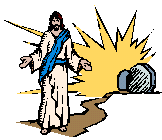
Just before daylight the next day, the most amazing thing happened! There was a GREAT EARTHQUAKE! An ANGEL from the Lord came down from heaven, moved the gigantic stone away from the door of the tomb and sat on it. The guards began to shake with fear! They fell down to the ground as if they were dead!

Mary and some other women had decided to get up very early in the morning and go to visit the tomb where Jesus was placed. While walking down the road, they were discussing how they were going to get inside the tomb. They had brought along some spices and perfume that they wanted to place on Jesus' body. They knew the huge stone had been placed in the doorway and they had no idea how they were going to move it.
What a SURPRISE they found when they reached the tomb! The stone had already been moved! And . . . there was an ANGEL sitting on the stone! The women were quite afraid, but the angel spoke gently to them:
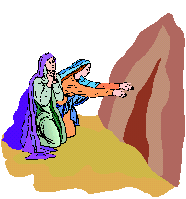
"Don't be afraid. I know that you have come to see Jesus. He is not here; for he is risen just as he said. Come inside and see the place where he lay."
The women went inside the tomb and found it empty, just as the angel had told them.
The angel spoke to the women one more time:
"Go quickly and tell the other disciples that Jesus has risen from the dead; and he is going into Galilee where you will see him."
The women did just as the angel had told them. They ran quickly from the tomb, with fear and great joy, to tell the good news to the other disciples. But . . . when the women found Peter and their other friends and tried to tell them the good news, . . . no one believed them!
When the women persisted, Peter decided that he needed to find out for himself.
He ran all the way to the tomb.
He went inside.
He saw the cloths that had been wrapped around Jesus, but the body was not there.
He wondered if it could possibly be true. Did Jesus really raise from the dead? Was Jesus really alive?
Two of Jesus' other friends were going on a journey to a village called Emmaus. As they walked and talked, they discussed all the things that had happened over the past few days. A man came along and joined the group. He walked along with them and wanted to join their discussion. Cleopas began telling the man about how Jesus was crucified on the cross. They talked about how the women found the empty tomb.
As they continued their journey, they invited the man to come in with them and have dinner. When they sat down to eat their meal, the man picked up a loaf of bread and broke it in pieces. Then he prayed for the meal and gave the bread to the men. At that very moment they realized that the man was JESUS! They had been talking to Jesus the whole time and didn't even know it!
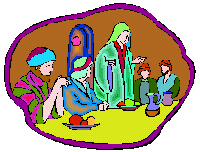
Then . . . ANOTHER strange thing happened. As soon as they realized who it really was that sat at the table with them . . . Jesus disappeared! They talked about the wonderful time they had talking with Jesus down the road, and they just couldn't help talking about his strange disappearance. They got up from their meal and returned to Jerusalem where they told all the other disciples the good news that Jesus REALLY DID raise from the dead and had talked with them.
As they were talking, Jesus again appeared to them. They were afraid and thought they were seeing a ghost, but Jesus told them not to be afraid. He showed them His hands and feet where He had been nailed to the cross, so they would believe that it was really Him.
When they saw the nail holes in His hands and feet, they finally believed that Jesus had risen from the dead, just like He said He would. They were soooo happy and joyful to have their friend with them again. They were soooo excited that they had to tell EVERYBODY the good news that JESUS IS ALIVE!

THINK!
Why were Jesus' friends so sad?
Why were guards placed around the tomb?
What caused the huge stone to be moved?
Who was the first to look inside the tomb?
Why was Jesus' body not in the tomb?
What did the angel say to Mary and the women with her?
A VERSE TO LEARN
"He is not here, but is risen" (Luke 24:6).
